| |
What is glaucoma?
Glaucoma is an eye disease that may cause loss of
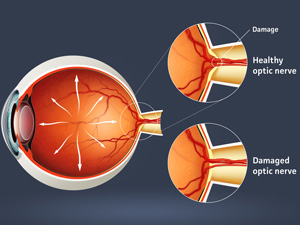
vision. It occurs as a result of a buildup of fluid
in the eyeball. Imagine that the inside of your
eye is like a sink, with the faucet always running
and the drain always open. Like water in the sink,
the fluid in your eye moves in and out. The fluid
nourishes your eye and keeps it healthy. After the
fluid circulates, it empties through a drain in
the front of your eye.
|
|
In
people with glaucoma, the drain in the eye is blocked
and the fluid can't run out of the eyeball. Instead,
the fluid builds up and causes increased pressure in
the eye.
How does increased pressure damage your eye?
The increased pressure in the eye destroys the nerve
cells in your eye, causing you to lose your vision.
At first, you may have blind spots only in your peripheral,
or side, vision. If your glaucoma isn't treated, your
central vision will also be affected. When glaucoma
causes vision loss, the loss is permanent. Nothing can
restore dead nerve cells.
What causes glaucoma?
The eye constantly produces aqueous, the clear fluid
that fills the anterior chamber (the space between the
cornea and iris). The aqueous filters out of the anterior
chamber through a complex drainage system. The delicate
balance between the production and drainage of aqueous
determines the eye’s intraocular pressure (IOP).
Most people’s IOPs fall between 8 and 21. However,
some eyes can tolerate higher pressures than others.
That’s why it may be normal for one person to
have a higher pressure than another.
Detection and Diagnosis
Because glaucoma does not cause symptoms in most cases;
those who are 40 or older should have an annual examination
including a measurement of the intraocular pressure.
Those who are glaucoma suspects may need additional
testing. The glaucoma evaluation has several components.
In addition to measuring the intraocular pressure, the
doctor will also evaluate the health of the optic nerve
(ophthalmoscopy), test the peripheral vision (visual
field test), and examine the structures in the front
of the eye with a special lens (gonioscopy) before making
a diagnosis.
The doctor evaluates the optic nerve and grades its
health by noting the cup to disc ratio. This is simply
a comparison of the cup (the depressed area in the center
of the nerve) to the entire diameter of the optic nerve.
As glaucoma progresses, the area of cupping, or depression,
increases. Therefore, a patient with a higher ratio
has more damage.
The progression of glaucoma is monitored with a visual
field test. This test maps the peripheral vision, allowing
the doctor to determine the extent of vision loss from
glaucoma and a measure of the effectiveness of the treatment.
The visual field test is periodically repeated to verify
that the intraocular pressure is being adequately controlled.
The structures in the front of the eye are normally
difficult to see without the help of a special gonioscopy
lens. This special mirrored contact lens allows the
doctor to examine the anterior chamber and the eye’s
drainage system.
Treatment
Most patients with glaucoma require only medication
to control the eye pressure. Sometimes, several medications
that complement each other are necessary to reduce the
pressure adequately.
Surgery is indicated when medical treatment fails to
lower the pressure satisfactorily. There are several
types of procedures, some involve laser and can be done
in the office, and others must be performed in the operating
room. The objective of any glaucoma operation is to
allow fluid to drain from the eye more efficiently.
Please call us at 770-448-5587 if you have any questions
or concern.
|